Yes, with limits: DUPLO is twice the linear size of LEGO in every dimension, so many even-stud LEGO bricks (think standard 2×2 and 2×4 bricks) clutch securely onto DUPLO studs. Plates, tiles, minifigures, and baseplates almost never work. Once you know the size rule and which pieces actually lock together, mixing the two systems opens up a lot of creative play. Below, you’ll find the physical explanation, a fast reference checklist, and building tips that keep hybrid projects stable enough for little hands.
TL;DR:
- Only standard 2×2 and 2×4 LEGO bricks with full underside tubes reliably grip DUPLO studs due to matching hollow tube geometry.
- Plates, tiles, minifigures, and baseplates generally do not connect securely to DUPLO bricks because they lack the proper clutch mechanism.
- Post-2002 DUPLO bricks provide more consistent clutch strength than older molds with taller internal ribs, especially when building with older or secondhand pieces.
- Mixing DUPLO and LEGO works best when using DUPLO as a sturdy base or skeleton, with LEGO bricks adding detail, and always testing fit before stacking multiple layers.
- Compatibility across LEGO lines like Juniors, Classic, and Friends depends on individual piece construction, but overall, most bricks with proper tube-and-stud geometry will connect regardless of theme.
Table of Contents
- Duplo Compatibility Guide: How the Connection Actually Works
- What Fits and What Doesn’t: Quick Reference Checklist
- How to Build Stable Mixed DUPLO and LEGO Projects
- Why Is My DUPLO-LEGO Connection Wobbly?
- Where to Buy and Budget Tips for Families
- Does DUPLO Work With LEGO Duplo Bricks Designed for Toddlers?
- How Have DUPLO’s Molds Changed Over the Years?
- Does DUPLO Work With LEGO Juniors, Classic, or Friends Sets?
- Is It Safe to Mix DUPLO and LEGO for Young Kids?
- Can Third-Party Brick Brands Connect to DUPLO?
- Mixed Play Isn’t a Workaround, It’s How Kids Grow Into Building
- Where to Start Building Your Hybrid Collection
- Sources
- FAQ
Duplo Compatibility Guide: How the Connection Actually Works
The whole system comes down to one ratio: DUPLO measures 2× the length, width, and height of a standard LEGO brick. That single multiplier means a DUPLO brick takes up a significantly larger volume than a LEGO System brick, and it’s why a DUPLO stud lines up perfectly with a 2×2 cluster of LEGO studs instead of a single stud.
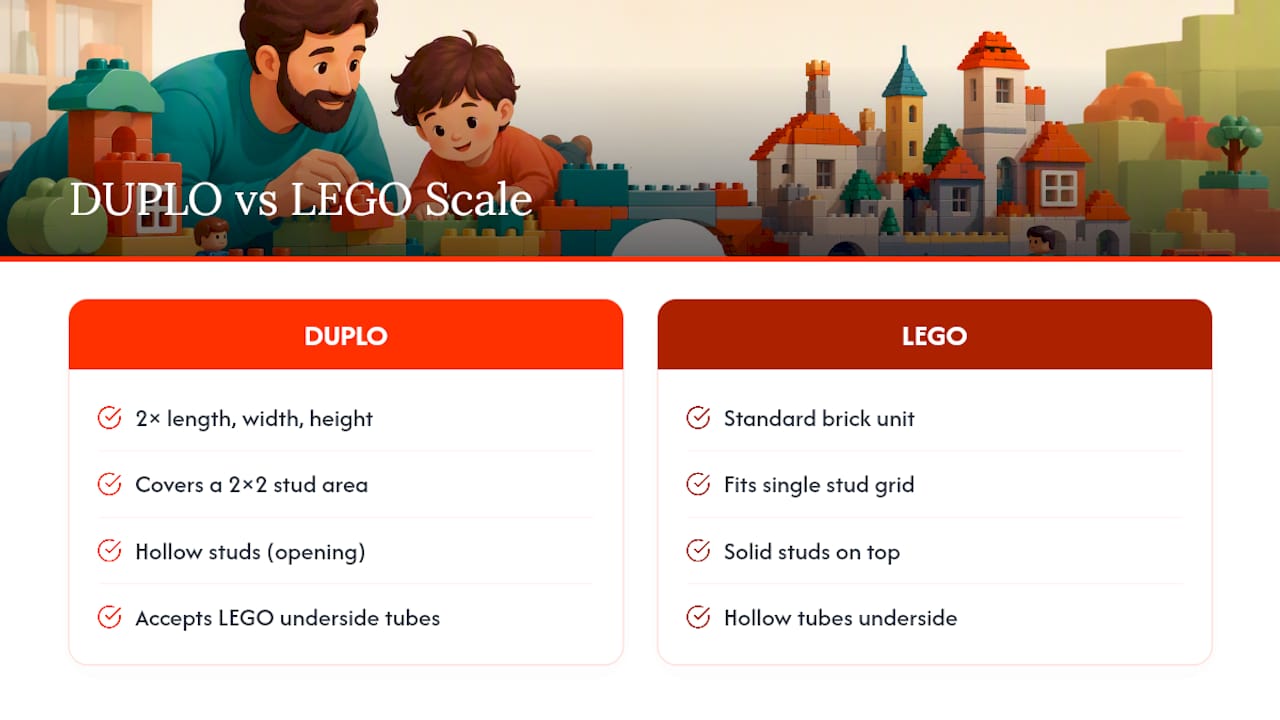
The mechanical part matters just as much as the math. DUPLO studs are hollow. Many LEGO bricks, especially standard 2×2 and 2×4 bricks, have hollow tubes on their underside that are sized to grip right around a solid LEGO stud or, in this case, fit down inside a DUPLO stud’s opening. That tube-to-stud friction is what creates “clutch power,” the resistance that keeps two pieces locked instead of just resting on top of each other.
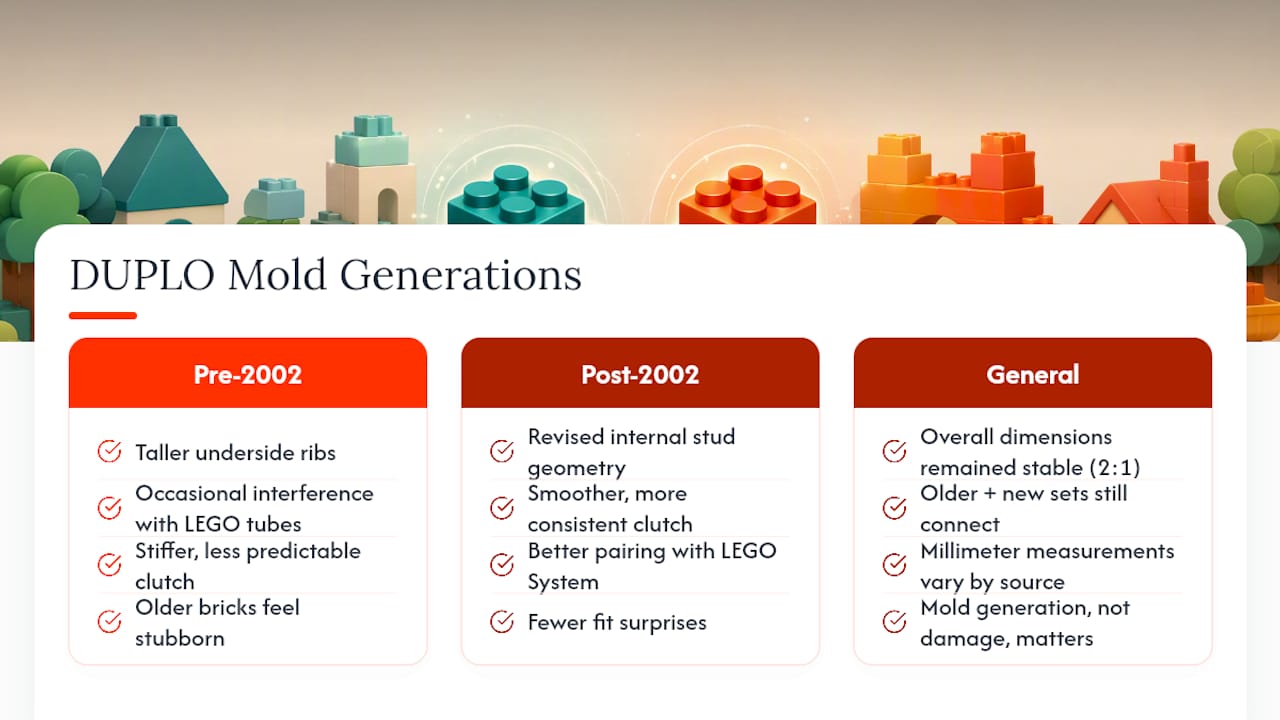
Here’s a detail most parents never hear about: DUPLO bricks made before 2002 used an older internal mold, with taller underside ribs that sometimes fought against LEGO tube geometry. Post 2002 DUPLO bricks generally give a more consistent, reliable grip. If you’ve got an older bin of DUPLO passed down from an older sibling or bought secondhand, that’s worth keeping in mind when a piece feels looser than expected.
What Fits and What Doesn’t: Quick Reference Checklist
Not every LEGO piece was built with DUPLO in mind, and knowing which ones were saves you a lot of frustrated toddler tears mid build. The LEGO Parts Guide confirms the core rule: standard LEGO bricks with appropriate underside tubes are the most dependable match because their underside tubes align with the wider DUPLO stud spacing.
Reliably compatible:
- Standard 2×2 and 2×4 LEGO bricks with full underside tubes
- Other even-stud bricks (2×6, 2×8) that share the same tube pattern
- Newer DUPLO bricks (post 2002 mold) paired with any of the above
Rarely or never compatible:
- LEGO plates and tiles, which are too thin to grip a DUPLO stud’s opening
- LEGO minifigures, which don’t scale to DUPLO figures at all
- Most Technic pieces, built around pins and axles rather than stud clutch
- DUPLO baseplates, which don’t share LEGO’s stud spacing
Curved pieces and odd width bricks (1×3, 1×1) are the gray zone. They may balance on a DUPLO stud for a moment, but they rarely deliver the locking clutch a moving toy needs. Treat anything that just “sits” rather than snaps as decorative, not structural.
How to Build Stable Mixed DUPLO and LEGO Projects
Mixing systems works best when you think of DUPLO as the skeleton and LEGO as the skin. DUPLO’s size and durability make it the natural foundation for anything a toddler will handle, while LEGO bricks add the smaller detail work that DUPLO alone can’t achieve.
- Start with a DUPLO base. Build your foundation, walls, or vehicle chassis entirely in DUPLO first. This gives you a sturdy, easy-to-grip structure before anything smaller enters the picture.
- Plan your transition row on an even stud grid. Before adding any LEGO piece, count the DUPLO studs you’re covering. A 2×4 LEGO brick needs a clean 2×4 footprint of DUPLO studs beneath it. Half-covering a stud almost always means a loose fit.
- Bridge gaps with tube-bearing bricks, not plates. If you need a flatter transition layer, use a LEGO brick turned on its side or a short stack, rather than reaching for a plate that won’t clutch at all.
- Reinforce anything that overhangs. If a LEGO detail extends past the DUPLO structure below it, add a support stack underneath rather than relying on the connection alone to hold the weight.
- Test-fit before you commit to a full build. Snap on the first LEGO piece and give it a gentle tug. If it wobbles, swap it for a different brick size before building three more layers on top of it.
Pro Tip: Keep a small “bridge bin” of loose 2×2 and 2×4 LEGO bricks specifically set aside for DUPLO projects. Having them presorted saves you from digging through a mixed bucket mid build, which is exactly when a toddler’s patience runs out.
Mirrored stud grids, where the LEGO layer’s stud pattern mirrors the DUPLO layer beneath it, tend to produce the most stable transitions, especially under load-bearing sections like roofs or vehicle roofs.
Why Is My DUPLO-LEGO Connection Wobbly?
A wobbly connection almost always traces back to one of three causes: partial stud coverage, an incompatible piece type, or an older DUPLO mold with worn or oversized internal ribs.
If a LEGO brick rocks side to side, check first whether it’s actually a plate or tile in disguise, since those parts were never designed to grip a DUPLO stud. If it’s a proper 2×2 or 2×4 brick and still loose, try swapping in a different brick from your bin. Slight manufacturing variance means one 2×4 might clutch tighter than another. Adding a supporting brick underneath an overhang almost always solves partial clutch issues.
One safety note worth repeating: if a piece requires real force to snap together, stop. Forcing an incompatible connection risks cracking a piece or creating a joint that releases unexpectedly during play, which is the last thing you want with a toddler nearby.
Where to Buy and Budget Tips for Families
Secondhand DUPLO is one of the better deals in the resale toy market. Families offload DUPLO fast once kids age out of it, which means local marketplaces and bulk lot listings often turn up large collections at a fraction of retail cost. Buying new makes more sense when you need pieces for a very young child (under 18 months, where DUPLO’s larger size matters for safety) or when a secondhand lot is missing key baseplates or figures.
A smart budget split: buy DUPLO in bulk secondhand for volume, then spend your new-purchase budget on specific LEGO pieces, particularly standard-sized bricks, that you’ll use to top your DUPLO builds. If you’d rather skip the sorting-through-bins process entirely, Affordable Bricks carries vetted, compatible sets with instructions confirmed to fit, which is a faster route to reliable hybrid pieces than a random resale lot.
Does DUPLO Work With LEGO Duplo Bricks Designed for Toddlers?
If you’re asking whether all DUPLO branded bricks work with each other, the answer is straightforward: yes. DUPLO is a single system regardless of which set it came from, so a brick from a farm playset connects to a brick from a train set without any conversion needed. The confusion usually comes from parents encountering “junior” or “my first” branded lines that use DUPLO scale bricks but different set theming.
What actually varies is age and mold generation, not compatibility within the line itself. A DUPLO brick from a 2010 set and one from a 2026 set share the same 2:1 scale relative to LEGO, and both will grip LEGO’s even-stud bricks the same way, assuming neither piece is damaged or worn. The bigger practical concern for parents mixing old and new DUPLO is wear, not design. A stud that’s been through a decade of chewing, dropping, and stepping-on may have looser clutch than a fresh piece, regardless of when it was molded.
One thing to watch for: some very early DUPLO branded toys (particularly pre-1980s Duplo from before LEGO standardized the modern stud pattern) used slightly different tolerances. These are rare in circulation today, and most secondhand DUPLO you’ll find at a garage sale or resale shop falls comfortably within the modern compatible range. If a piece looks unusually chunky, discolored, or has a stud shape that looks different from your other bricks, treat it as a display piece rather than a structural one until you’ve test-fit it.
How Have DUPLO’s Molds Changed Over the Years?
The single biggest shift in DUPLO’s design history happened around 2002, when LEGO revised the internal stud geometry to improve how DUPLO bricks grip both each other and LEGO System pieces. Before that change, DUPLO’s underside ribs sat taller inside the stud cavity, which occasionally interfered with the tube geometry on standard LEGO bricks and produced a stiffer, less predictable connection.
Post 2002 DUPLO bricks generally offer smoother, more consistent clutch when paired with LEGO’s tube-equipped bricks. If you’ve ever wondered why one DUPLO brick in your bin snaps LEGO pieces on easily while another from an older set feels stubborn, mold generation is very likely the reason, not damage or manufacturing defect.
Beyond the 2002 change, DUPLO’s overall dimensions have stayed remarkably stable. The 2:1 scale relationship to LEGO System bricks has held for decades, which is part of why a DUPLO farm set from years ago still connects to a brand new LEGO 2×4 brick without issue. That consistency is intentional. LEGO has kept DUPLO’s stud spacing fixed specifically so that older sets remain usable alongside newer purchases, letting siblings and hand-me-down collections work together across years of play.
Community researchers have measured DUPLO bricks down to the millimeter using tools like LDraw and Thingiverse models, but these measurements vary slightly between sources. They’re useful for 3D modeling or custom part design, but not something you need to worry about for everyday play. What matters for a family building at the kitchen table is the mold generation, not the millimeter.
Does DUPLO Work With LEGO Juniors, Classic, or Friends Sets?
DUPLO’s compatibility isn’t about which LEGO product line a piece comes from. It’s about brick geometry, and that means LEGO Juniors, LEGO Classic, and LEGO Friends all follow the same rules as any other LEGO System line.
LEGO Juniors, designed as a bridge line for kids aging out of DUPLO, uses standard LEGO System dimensions, not DUPLO scale. That means Juniors bricks behave exactly like regular LEGO when paired with DUPLO: even-stud bricks with underside tubes will clutch, while the line’s simplified baseplates and larger connector pieces generally won’t.
LEGO Classic sets are built entirely from standard System bricks, so they follow the checklist covered earlier without exception. A basic brick bucket often includes exactly the parts that pair best with DUPLO: 2×2s, 2×4s, and other even width bricks with full tube undersides.
LEGO Friends sets introduce more specialty pieces, curved walls, thin decorative elements, and stylized furniture, that tend to fall into the incompatible or unreliable category. The structural bricks within Friends sets still follow standard System geometry and will work fine on DUPLO, but the decorative pieces that make Friends sets visually distinct usually won’t provide a secure clutch.
The practical takeaway for parents shopping across product lines: judge compatibility by the individual piece, not the box it came in. A Classic bucket and a Friends playset can both contribute usable bricks to a DUPLO hybrid build. You’re looking for the same tube-and-stud geometry regardless of which themed set the brick was pulled from.
Is It Safe to Mix DUPLO and LEGO for Young Kids?
DUPLO exists specifically because standard LEGO bricks pose a choking risk for children under three, and mixing the two systems means that risk doesn’t disappear just because a build starts with a DUPLO foundation.
LEGO’s own guidance on building with DUPLO and LEGO together is clear that the two lines are designed with different age recommendations in mind, and mixed builds should follow the younger child’s safety threshold whenever both age groups will be playing with the same model. In practice, that means if a toddler under three has access to the model, keep the LEGO detail pieces large enough that they can’t be a choking hazard, or supervise closely and remove small elements when playtime ends.
A hybrid build intended for a mixed age household, say, a 2 year old and a 6 year old sharing a play bin, works best when parents treat it as two separate zones. Let the older child add small LEGO detail work under supervision, then either disassemble those additions or store the finished model out of reach before the toddler gets free access again. Loose LEGO pieces mixed into a toddler’s DUPLO bin, even if they started as part of a supervised build, are the actual risk, not the connection itself.
If you’re building with a child young enough to still mouth toys, the safest approach is simply to skip mixed builds for now and revisit them once the youngest player in the house has aged past the choking hazard window.
Can Third-Party Brick Brands Connect to DUPLO?
Third-party brick systems marketed as LEGO compatible generally follow standard LEGO System dimensions, which puts them in the same boat as any other LEGO brand piece: even-stud bricks with proper underside tubes have a reasonable shot at clutching a DUPLO stud, while plates and specialty shapes usually won’t.
The catch is consistency. Official LEGO bricks are manufactured to extremely tight tolerances, which is part of why the 2:1 DUPLO relationship holds up so reliably across sets and years. Third-party manufacturers vary widely in how closely they match those tolerances, so a compatible brand 2×4 brick might grip a DUPLO stud beautifully, while a different brand’s version from the same category feels loose or overly tight.
If you’re building a mixed model with a child present, test-fit any third-party piece before relying on it structurally, the same rule that applies to older DUPLO molds. A part that only balances instead of locking isn’t worth the frustration of a mid-play collapse, regardless of what brand made it.
For parents who want predictable results without testing every brick from an unfamiliar source, sticking with official LEGO System pieces for the detail layer of a DUPLO hybrid build remains the most reliable option. It’s one less variable to manage when you’re also managing a toddler’s attention span.
Mixed Play Isn’t a Workaround, It’s How Kids Grow Into Building
DUPLO and LEGO aren’t competing systems that happen to share a name. They’re designed as a progression, and the compatibility gap between them is intentional scaffolding, not a limitation to work around. A child who builds a DUPLO tower today and adds their first LEGO detail bricks next year is following exactly the path the two lines were built for.
What we’ve seen matter most is instructions that actually account for this transition, sets where every piece is confirmed to fit as described, rather than leaving families to guess whether a stud will hold.
— Affordable
Where to Start Building Your Hybrid Collection
Some online stores stock premium, compatible sets with instructions built to make every piece fit the way it’s supposed to, no guessing whether a brick will clutch or wobble loose halfway through a build. That’s the kind of quality control that matters most when you’re building alongside a toddler who has zero patience for a piece that doesn’t snap in on the first try.
A few starting points worth browsing if you’re stocking up on detail pieces for a hybrid project:
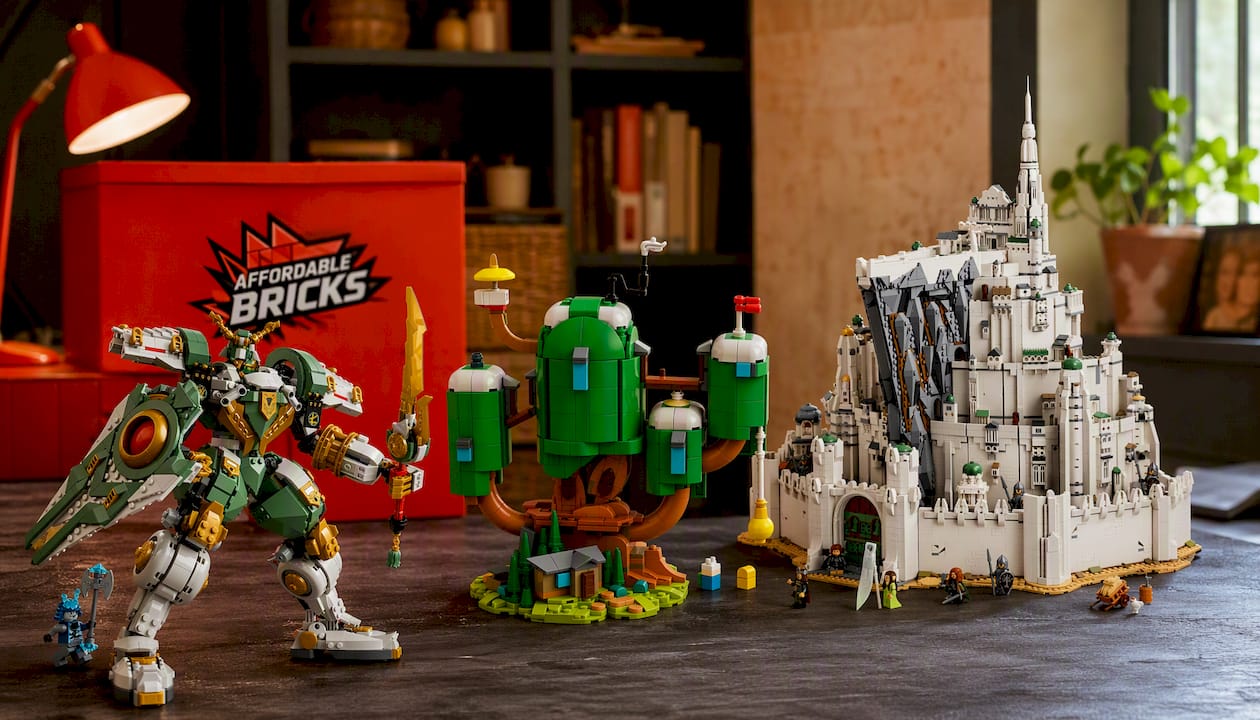
- The Lloyd Mech 71860, a detail-rich build that works well as the “topping” layer once you’ve got a DUPLO foundation in place.
- The Adventuring Scale Down Treehouse 3040, a compact creative set that pairs naturally with a DUPLO base for imaginative play scenes.
- The M Tirith 11377, a larger set for families ready to layer more ambitious LEGO detail onto a sturdy DUPLO core.
Military members and veterans get a discount on any order, and every set ships with instructions confirmed piece-for-piece before it reaches your door. Browse the full collection of replica sets and themed kits to find your family’s next build, or check out the vehicles collection if your hybrid project has wheels in its future.
Sources
Community measurement projects, like the dimension discussion on Bricks Stack Exchange, add useful detail for modeling but vary between sources, so treat the linked guides above as the reliable baseline.
FAQ
Which LEGO Bricks Are Compatible With DUPLO?
Standard even-stud LEGO bricks with full underside tubes, especially 2×2 and 2×4 bricks, are the most reliable match because their tube spacing lines up with a DUPLO stud’s hollow opening.
Are DUPLO Bricks Compatible With Regular LEGO Bricks?
Yes, with real limits: DUPLO’s 2:1 scale means many standard bricks clutch securely onto DUPLO studs, but plates, tiles, minifigures, and baseplates generally don’t connect at all.
What Is the 5/2 Rule in LEGO?
This isn’t a recognized LEGO building standard. The rule that actually governs DUPLO and LEGO compatibility is the 2:1 scale relationship, where DUPLO measures twice the length, width, and height of a standard LEGO brick.
What LEGO Bricks Fit DUPLO Bricks Specifically?
Bricks built around a full underside tube grid, most commonly 2×2, 2×4, and other even width System bricks, fit DUPLO reliably, while single width bricks and anything without tubes tend to just sit loosely instead of locking in.
Does Affordable Bricks Sell Sets That Work With DUPLO?
Affordable Bricks carries LEGO compatible replica sets, including detail focused builds like the Lloyd Mech 71860, that work well as the LEGO layer on top of a DUPLO foundation. Current prices are listed on the site.