Around $0.10 to $0.12 per piece is the current retail average, so anything under $0.08 counts as an excellent deal and anything over $0.16 is pricey for standard sets. That’s the whole rule of thumb. But price per piece only tells part of the story: it ignores licensing costs, big molded parts, and printed pieces, so use it as a first filter, not the final word.
TL;DR:
- Price per piece is a useful initial filter but must be adjusted for licensing costs, large molded parts, and printed elements that inflate the number.
- Comparing retail and sale prices helps identify true deals, with discounts often dropping the price per piece below $0.08 for build-to-sell sets.
- Category-specific benchmarks show System and Technic sets typically range from $0.10 to $0.13 per piece, while licensed sets tend to be higher due to licensing fees.
- Resale prices often exceed retail per-piece costs, especially for discontinued or rare sets, making resale value calculations different from building bargains.
- Always verify the actual price paid, use official piece counts, and consider build quality alongside price per piece for the best value.
Table of Contents
- LEGO Price Per Piece Calculator and Value Tiers
- How to Calculate Price Per Piece the Right Way
- Why Price Per Piece Can Mislead You
- Retail, Sale, and Resale: How Price Per Piece Shifts Over Time
- Category Benchmarks and Worked Examples
- How Affordable Bricks Looks at Price Per Piece
- Shop Sets With a Strong Price Per Piece
- Where These Price Per Piece Benchmarks Come From
- Sources
- FAQ
LEGO Price Per Piece Calculator and Value Tiers
The math is simple: divide the set price by the total piece count. A $99.99 set with 1,000 pieces comes out to $0.10 per piece, right at the current average retail benchmark tracked across thousands of sets.
Here’s where that number actually helps you. Once you have a price per piece, drop it into a tier:
- Excellent deal: under $0.08 per piece
- Good value: $0.08 to $0.11 per piece
- Average, expect this on most new releases: $0.12 to $0.15 per piece
- Pricey, look closer before buying: over $0.16 per piece
Pro Tip: *Run the same set through this math twice: once at full retail (MSRP) and once at the actual sale price you’re being offered.
Which price should you actually plug in? Use MSRP when you want a baseline comparison across sets. Use the live sale price when you’re deciding whether to buy right now. Resale listings need their own separate calculation, since secondary-market pricing behaves nothing like retail. Tools built for this, like the tiered PPP calculator from Brick by Brick Fun, auto-fill piece counts and MSRP so you’re not hunting for numbers on a box.
How to Calculate Price Per Piece the Right Way
Getting an accurate cost per LEGO piece takes three steps, and skipping any of them gives you a number that lies to you.
- Confirm the real price. Use the price you’d actually pay today, whether that’s MSRP or a discounted sale price, not a number you remember from last year.
- Confirm the official piece count. Pull this from the box or the official product listing, never an estimate.
- Divide price by piece count. That’s your price per piece.
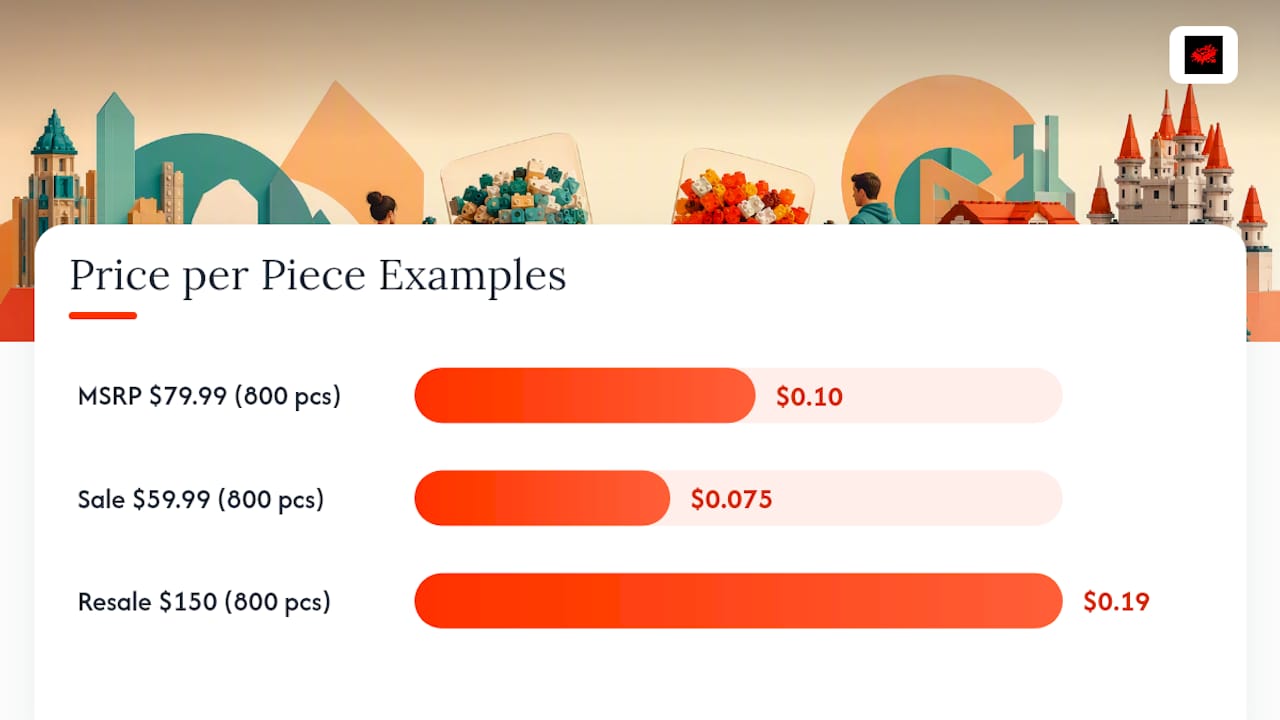
A few worked examples: a $79.99 set with 800 pieces runs $0.10 per piece at MSRP. Drop that same set to $59.99 during a sale and it falls to $0.075, an excellent deal. A retired set reselling for $150 with the same 800 pieces jumps to $0.19 per piece, well into pricey territory.
Watch for pitfalls. Bundled extras (a display case, a bonus minifigure pack) inflate the price without adding build pieces. Promotional sets given away with a purchase shouldn’t be averaged into your calculation at all, since their “price” is really $0.
Why Price Per Piece Can Mislead You
A low price per piece doesn’t automatically mean a better set, and a high one doesn’t mean you’re getting ripped off. Several factors distort the number in both directions.
- Licensing and royalties push up the price of officially branded sets regardless of part count. A licensed superhero or franchise set costs more per piece simply because of what’s printed on the box, not because the plastic is different.
- Large molded parts, electronics, and printed elements raise price per piece fast. A single motor, light brick, or oversized wing panel can cost more than fifty small studs combined, and that count still shows up as “one piece” in the math.
- Tiny bulk elements work the opposite direction. Mosaic and Art-style sets pack in thousands of 1x1 tiles, which tanks the per-piece price even though the actual building experience is repetitive by design.
The fix is to compare within categories instead of across them, since System and Technic sets typically land around $0.11 to $0.13 per piece, while licensed and specialty lines run higher for reasons that have nothing to do with quality. Price per piece is a quick filter, not a full valuation, and treating it as gospel across every theme is where most buyers go wrong.
Retail, Sale, and Resale: How Price Per Piece Shifts Over Time
The same set can carry three very different price-per-piece numbers depending on where it sits in its life cycle. Retail PPP is the baseline you calculate at launch. Sale PPP drops during clearance events, Black Friday, or retirement announcements, often producing the best deals you’ll ever see on that set. Resale PPP tells a completely different story once a set leaves shelves for good.
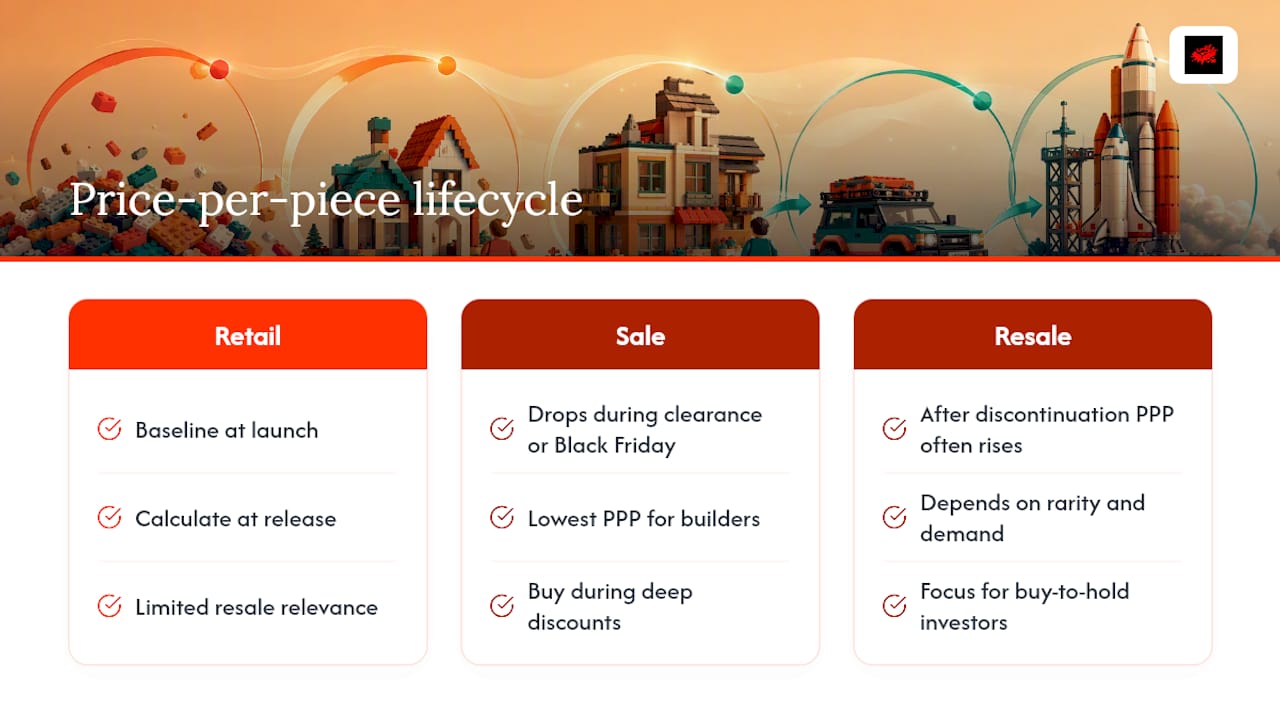
Discontinued sets frequently see resale price per piece climb well above their original retail number, sometimes by several cents per piece depending on rarity, as collectors chase sets that will never restock.
If you’re buying to build, chase the deep discount sales for the lowest PPP. If you’re buying to hold for resale value, retail PPP barely matters. What matters is rarity, demand for specific minifigures, and how limited the run was.
Category Benchmarks and Worked Examples
Benchmarks shift depending on what kind of set you’re pricing. Rough ranges to keep in mind:
- System sets (standard city, town, everyday builds): $0.10 to $0.13 per piece
- Technic sets: often runs higher due to specialized gears and pins
- Art and mosaic sets: typically lower per piece since they’re built from thousands of tiny tiles
- Licensed sets (franchise, character-driven): usually the highest, driven by royalty costs rather than part complexity
Two quick worked examples show the method in action. A large system-style set at $179.99 with 1,500 pieces comes out to $0.12 per piece, squarely average. A licensed set at $89.99 with 480 pieces works out to $0.19 per piece, pricey by the numbers, though a big chunk of that comes from character licensing rather than the plastic itself.
Before you buy, run this quick checklist:
- Calculate PPP at the price you’re actually paying.
- Compare that number against sets in the same category, not the overall average.
- Ask whether large parts, electronics, or licensing explain a higher number.
- Decide whether you’re buying for the build experience or the resale shelf.
How Affordable Bricks Looks at Price Per Piece
Price per piece is the first number Affordable Bricks checks on every compatible set before it goes on the site, but it’s never the only number. A set can post an excellent price per piece and still be a poor buy if the pieces don’t fit together correctly or the instructions are unclear, so quality control on compatibility gets checked alongside the math.
Compared to official LEGO sets, compatible sets can post a noticeably lower price per piece for a similar part count and build experience. That gap is worth investigating set by set rather than assuming it always holds. When you’re comparing an Affordable Bricks set against an official release, run both through the same PPP formula, then weigh part quality and instruction clarity, not just the final cents-per-piece number. A low price per piece paired with loose-fitting pieces is a worse deal than a slightly higher price with a build that clicks together the way it should. That’s the standard worth applying to any compatible sets you’re considering for your shelf.
— Affordable Bricks Editor
Shop Sets With a Strong Price Per Piece
Affordable Bricks focuses on getting your price per piece right without cutting corners on fit or instructions, which is the trade-off that trips up a lot of off-brand alternatives. You’re not choosing between cheap and reliable here. You get both, plus discounts for military and first responders.

A few sets worth running through the calculator yourself: the Lord Helmet 75304 is a great test case for a smaller, display-focused build, while the Wizard Bank 76417 gives you a mid-size piece count to compare against official pricing. If you want a bigger build to stress-test the math, check the Main Street 43302 and see how its price per piece stacks up against a similar official city-theme set.
Want to browse more before you decide? Head to the full Affordable Bricks catalog or check out the vehicle sets if you’re building out a fleet. Every product page lists the piece count up front, so you can run your own price per piece check before you check out.
Where These Price Per Piece Benchmarks Come From
- LEGO Brick Set Price Tracker for retail, sale, and resale price-per-piece trends
- Brick Insights for category-adjusted benchmarks across themes
- Brickonomics for sortable price-per-piece tables across live listings
Sources
- LEGO™ Brick Set Price Tracker — Price per brick explained
- Brick Insights — LEGO price per part over the years
- Brickonomics — Price per piece tables and lists
FAQ
What is the average LEGO price per piece?
The current retail average sits around $0.10 to $0.12 per piece across recent sets, though System and Technic themes typically land closer to $0.11 to $0.13.
What is the LEGO 5:2 rule?
There’s no widely recognized rule tied to LEGO pricing or piece counts. Definitions circulating online vary and aren’t backed by a standard source, so treat any claim about it with caution.
How much does one LEGO piece cost?
One piece typically costs somewhere between $0.08 and $0.15 at retail, depending on the set’s theme, licensing, and part complexity. Sets built from tiny bulk elements often price lower per piece, while sets with large molded parts or licensing run higher.
How much does a 500-piece LEGO set cost?
At the current retail average of $0.10 to $0.12 per piece, a set’s price generally matches the expected range for its piece count. Compatible sets, including several from Affordable Bricks, can offer a similar piece count for less without sacrificing fit or instruction quality.